What should happen, and with whom.
Production planning turns released orders into a plan: what runs on which machine, when, and with which people. The planner stays in charge.
What it does
Automatic scheduling
A fast, repeatable planner or a constraint optimiser, with the goal you choose: on-time delivery, balance or saturation.
Draft before you commit
The scheduler proposes a draft, compares it with the current plan, and you apply it or discard it.
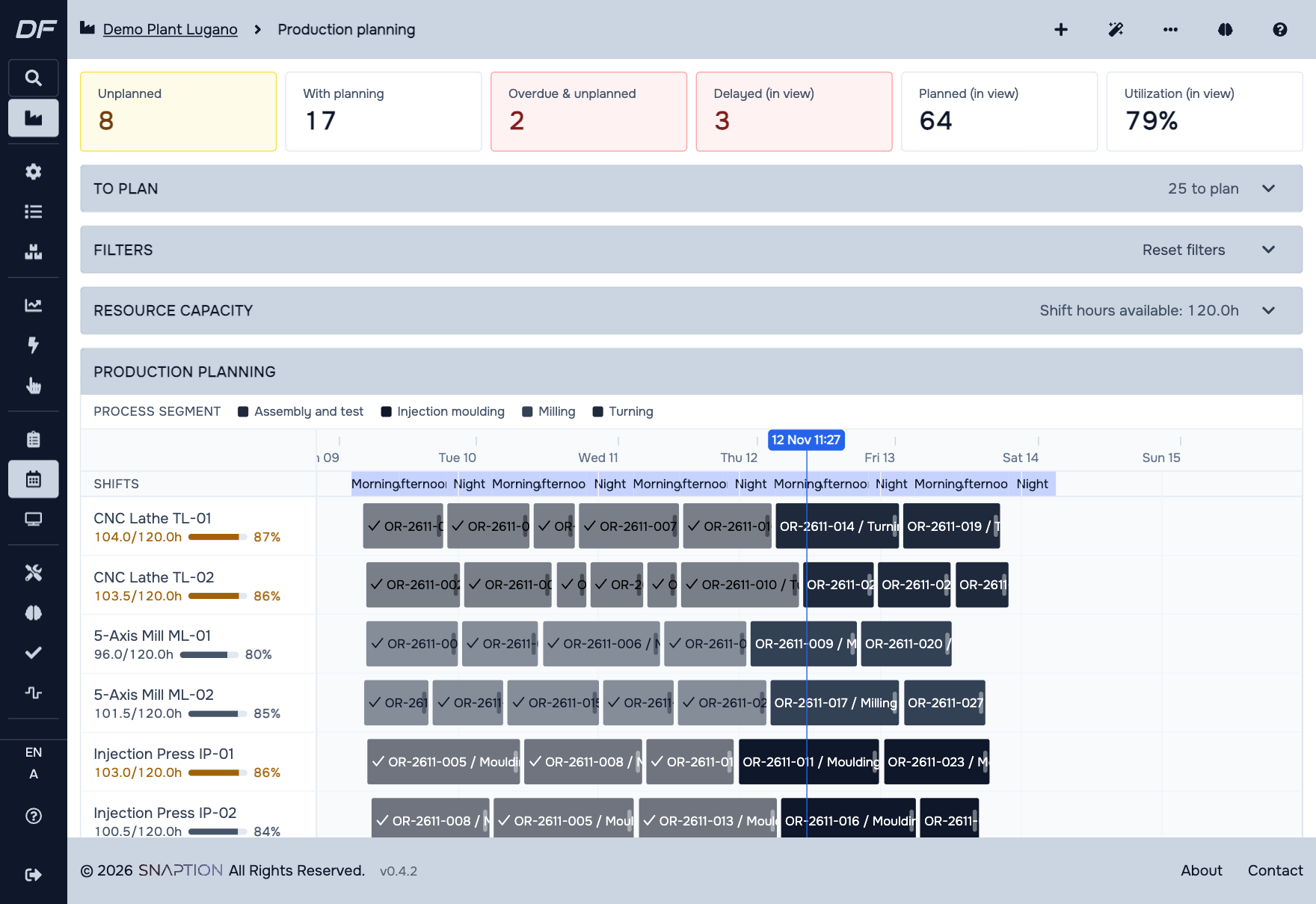
Planning Gantt
Planned activities per machine, unplanned orders, and a strip of plan indicators above.
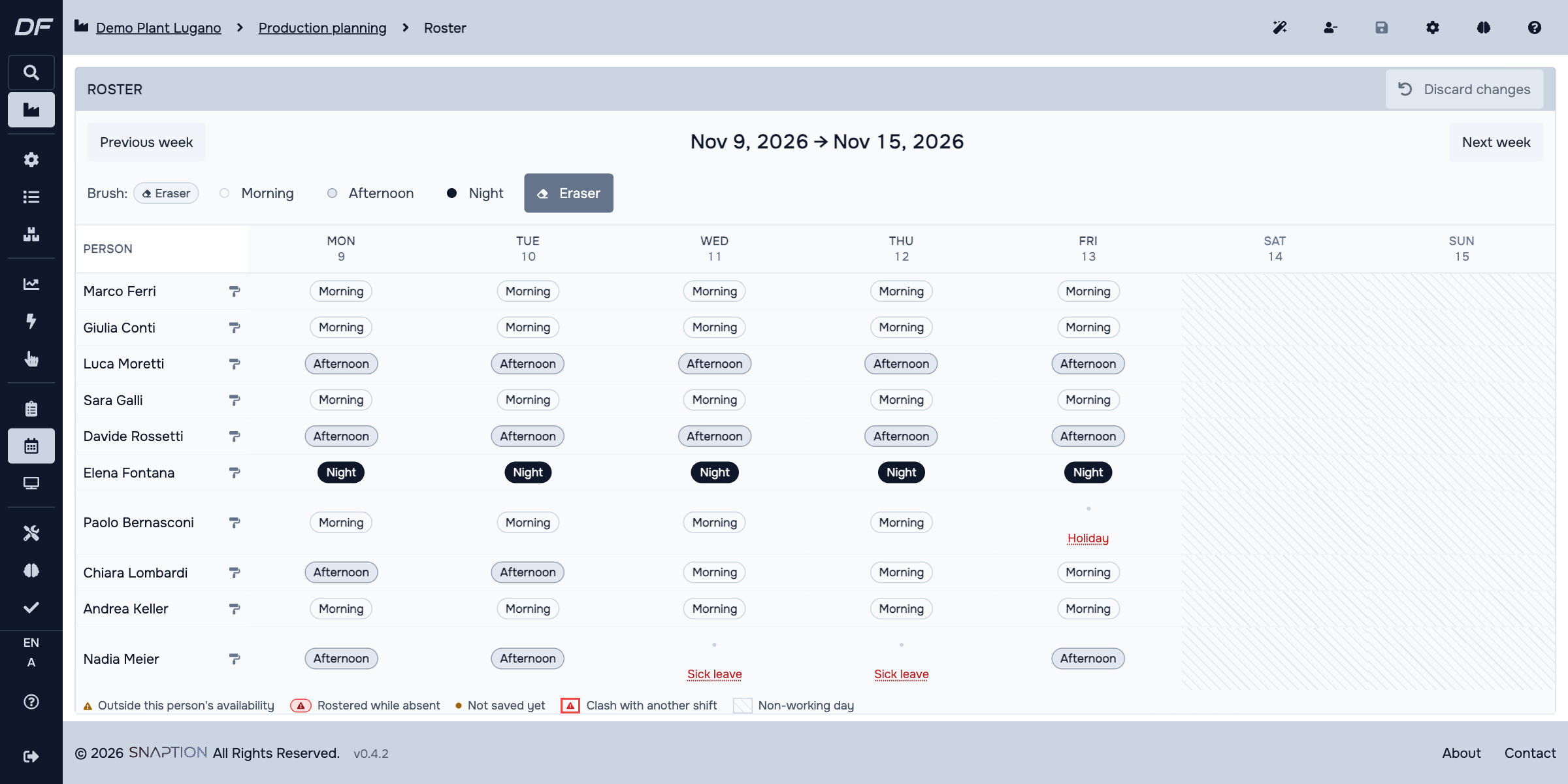
Staff rosters
Rosters with rules, such as a cap on night shifts, generated up to 8 weeks ahead. The plan respects who is actually present.
Plan health and shift fairness
See late and at-risk orders days before the delivery date, and how shifts are shared between people.
Work sheets
Print the sheets for the department from the plan.
The data it stands on
Like every module, it reads the shared ISA-95 model. Nothing is copied into a separate database.
- Released orders with their steps and dependencies
- Products, routings and bills of materials from the Catalog
- Machines and work centers from the site model
- Shifts, closures and people of the site
What it measures
- Orders planned late
- Orders at risk in the next 7 days
- Machine utilisation against shift capacity
- Makespan
- Unplanned orders
- Roster coverage and shift fairness
The agent that works with it
The Pacer reads orders with their steps, and the routings, rates and bills of materials in the Catalog, so a planner can ask where an order stands or what a product needs.
See DigiFactor on your own data.
Book a demo with our engineers. We show the platform, the modules and the agents on a case close to yours.
Book a demo We answer within one business day